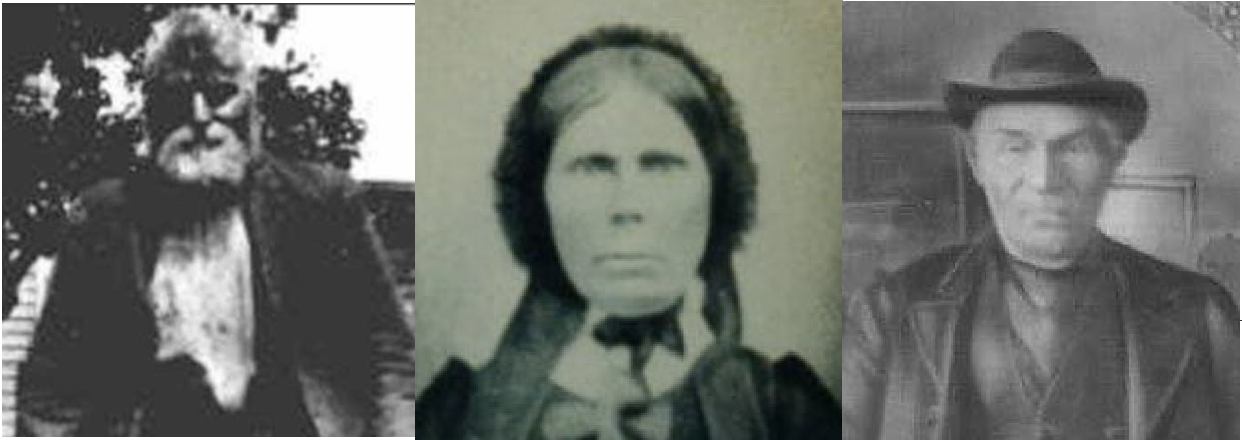
After the publishing of the article concerning the parentage of Marie (Brake) Companion, a number of readers asked for more information on the early Brake family of the Bay of Islands. Much information is available online and otherwise, however two historical records which provide key details of the early family, are not readily available to viewers online. One is an 1871 Lecture from the well-known Reverand Michael Francis Howley (1843-1914) and another is the will of Brake patriarch Ralph Brake (1760-1842), These have been made available below for Brake family researchers:
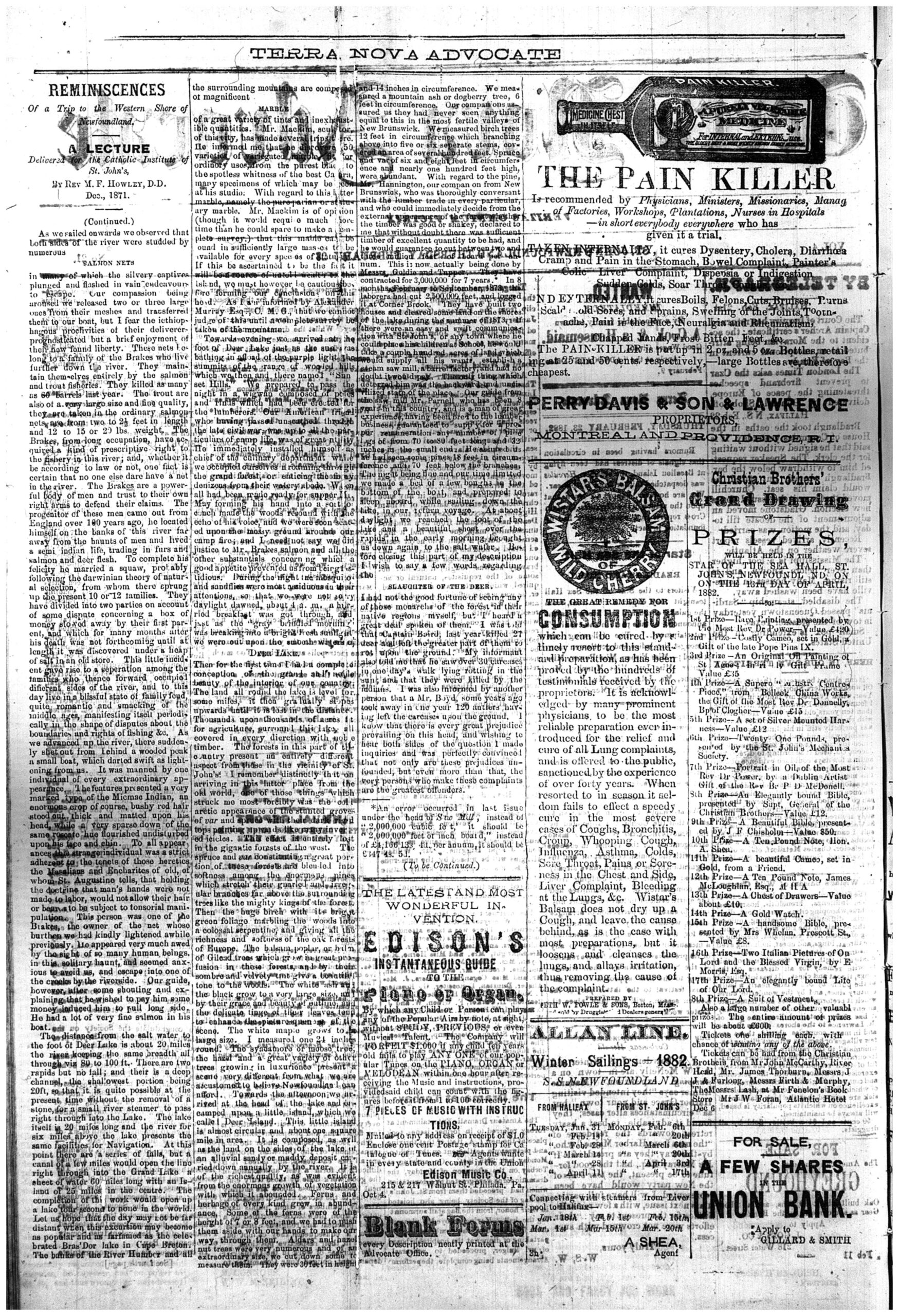
TERRA NOVA ADVOCATE, FEBRUARY 23, 1882 EDITION, PAGE 2:

“REMINISCENCES
Of a Trip to the Western Shore of Newfoundland
A LECTURE
Delivered for the Catholic Institute of St. John’s,
Dec., 1871.
By Rev. M. F. Howley, D.D.
(Continued.)
As we sailed onward we observed that both sides of the river were studded by numerous—
SALMON NETS
in many of which the silvery captives plunged and dashed in vain endeavors to escape. Our compassion being aroused we released two or three of these ones from their meshes and transferred them to our boat, but I fear the ichthyophagous proclivities of their deliverer prognosticated but a brief enjoyment of their new-found liberty. These nets belong to a family of the Brakes who live further down the river. They maintained themselves entirely by the salmon and trout fisheries. They killed as many as 60 barrels last year. The trout are also of a very large size and fine quality; they are taken in the ordinary salmon nets from two to 2.5 feet in length and 12 to 15 or 20 lbs. weight. The Brakes, from long occupation, have acquired a kind of prescriptive right to this fishery in this river; and, whether it be according to law or not, one fact is certain that no one else dare have a net in the river. The Brakes are a powerful body of men and trust to their own right arms to defend their claims. The progenitor of these men came out from England over 100 years ago; he located himself on the banks of this river far away from the haunts of men and lived a semi-Indian life, trading in furs and salmon and deer flesh. To complete his felicity he married a squaw, probably following the Darwinian theory of natural selection, from whom there sprung up to the present 10 or 12 families. They have divided into two parties on account of some dispute concerning a box of money stowed away by their first parents, and which for many months after his death was not forthcoming until at length it was discovered under a heap of salt fish in an old store. This little incident gave rise to a separation among the families who thence forward occupied different sides of the river, and to this day live in blissful state of family feud; quite romantic and smacking of the middle ages, manifesting itself periodically in the shape of disputes about the boundaries and rights of fishing etc. As we advanced up the river there suddenly shot out from behind a wooded peak a small boat, which darted swift as lightening from us. It was manned by one individual of every extraordinary appearance. The features presented a very marked type of the Micmac Indian, an enormous crop of coarse, bushy black hair stood out thick and matted upon his head, while a very sparse down of the same roseate hue also flourished undisturbed upon his face and chin. To all appearances this strange individual was a strict adherent to the tenets of those heretics, the Messiahs and Encharites of old, of whom St. Augustine tells, that holding the doctrine that man’s hands were not made to labor, would not allow their hair or beards to be subject to tonsorial manipulation. The person was one of the Brakes, the owner of the net whose burthen we had kindly lightened awhile previously. He appeared very much awed by the sight of so many human beings in this solitary haunt, and seemed anxious to avoid us, and escape into one of the creeks by the riverside. Our guide, however, informed me jokingly and explaining that he wished to pay him some money induced him to pull long side. He had a lot of very fine salmon in his boat.”
Historical Context of the above:
Rev. M. F. Howley, D.D. (Michael Francis Howley)
Michael Francis Howley (1843–1914) later became the first Archbishop of St. John’s, Newfoundland. In 1871, when this lecture was delivered, he was a young Catholic priest. His writings often combined travel narrative, clerical commentary, classical references, and moral observation—typical of 19th-century educated clergy.
The Catholic Institute of St. John’s
A Catholic literary and social organization founded in the 19th century in St. John’s. Such institutes hosted lectures, debates, and intellectual discussions. Public lectures like this were popular forms of both education and entertainment.
The Micmac (Mi’kmaq) Indian
The Mi’kmaq are the Indigenous people of Atlantic Canada, including Newfoundland. In the 18th and 19th centuries, many Mi’kmaq families in Newfoundland were involved in hunting, trapping, guiding, and trade. European settlers frequently intermarried with Mi’kmaq women, especially in remote areas such as the Humber River region. The spelling “Micmac” reflects older colonial orthography; today, Mi’kmaq is preferred.
“Darwinian theory of natural selection”
A reference to Charles Darwin’s theory of evolution by natural selection, first widely introduced in 1859 in On the Origin of Species. By 1871, Darwin’s ideas were still controversial—particularly in Catholic circles. Howley’s remark is lightly ironic, suggesting the English progenitor “selected” a suitable partner in a frontier environment. The comment reflects how evolutionary theory had already entered public discourse, even in Newfoundland.
Messiahs and Encharites (likely Encratites)
The “Messiahs and Encharites” appear to refer to early Christian sects described by Church Fathers such as Augustine of Hippo (St. Augustine). The Encratites (2nd century) were an ascetic sect that rejected marriage and promoted extreme bodily discipline. Augustine wrote about various heretical sects in works such as De Haeresibus. Howley suggests that the unkempt fisherman resembled such ascetics who rejected grooming (“tonsorial manipulation”).
“Smacking of the Middle Ages”
This phrase reflects a 19th-century romantic fascination with medieval Europe. The notion of feuding families living along opposite riverbanks echoes medieval clan rivalries. Victorian writers frequently romanticized such disputes as picturesque rather than tragic.
Prescriptive Right
A legal concept derived from English common law. A “prescriptive right” refers to a right acquired through long, continuous use (similar to adverse possession). In 19th-century Newfoundland, fishing rights were often informally enforced through custom and local power rather than formal law.
Salmon Fisheries in 19th-Century Newfoundland
The Humber River and Deer Lake region were major salmon-producing areas. Salmon were packed in barrels and exported. A yield of “60 barrels” would have represented significant economic production for a single extended family.
The Word “Squaw” — Historical Context
Jane Matthews (abt 1775 – August 23, 1819) was the wife of Brake patriarch Ralph Brake.
Jane is referred to as a “squaw” in the passage: “he married a squaw…”
The word derives from an Indigenous Algonquian-language root. In several Eastern Algonquian languages (including Massachusett and related dialects), words similar to squa or iskwew simply meant “woman” or “young woman.” By the 17th century, English colonists adopted the word into frontier English as a general term for Indigenous women. In 19th-century writing (including missionary and travel literature), it was commonly used descriptively. The term is now widely regarded as offensive.
“Ichthyophagous proclivities”
Ichthyophagous is Greek meaning “fish-eating. Proclivities means natural tendencies or inclinations. So the phrase literally means: “fish-eating tendencies.”
What Howley Means in Context
In the passage, Howley writes that although they released a few salmon from the Brake’s nets:
“…I fear the ichthyophagous proclivities of their deliverer prognosticated but a brief enjoyment of their new-found liberty.”
He is humorously admitting that although they freed the fish out of compassion, the person who freed them (likely someone in their own party) probably intended to eat them soon anyway. So their “liberty” would be short-lived.
THE LAST WILL AND TESTAMENT OF RALPH BRAKE:
As transcribed by Daphne Park & Linda Elkins-Schmitt on the Newfoundland Grand Banks website (available here):
“This is the last Will and Testament of me Ralph BRAKE of the Bay of Islands in the Island of West Newfoundland Planter. First I will and direct that all my just debts and Funeral and testamentary expenses shall be fully paid and ? satisfied by my Executors hereinafter named. I give and bequeath unto my son John Matthews BRAKE the sum of forty pounds, also give and bequeath unto my son Joseph Matthews BRAKE the sum of one hundred pounds. Also give and bequeath unto my daughter Elizabeth Matthews, the wife of Thomas PARK of the Bay of Islands aforesaid the sum of twenty pounds. Also I give and bequeath I unto my daughter Jane Matthews the wife of William WHELLOR of the Bay of Islands aforesaid the sum of twenty pounds and also I give and bequeath unto my son Robert Matthews BRAKE the sum of one hundred pounds which said five legacies of forty pounds one hundred pounds, twenty pounds, twenty pounds and one hundred pounds. I will and direct shall be paid by my said Executor out of my property in England and all and singular the cost residue and remainder of the property which I shall be possessed of or entitled to at the time of my decease or over which I have a disposing power or whether the same consists of money in the funds or otherwise upon security or a interest book and other debts, stock in trade or what ever other sort or kind the same or any part thereof may be.
I give, devise and bequeath the same unto my sons Robert Matthews BRAKE, Ralph Matthews BRAKE, William Matthews BRAKE, Thomas Matthews BRAKE, James Matthews BRAKE and Edward Matthews BRAKE their heirs executors administrators and assigns equally between them, share and share alike so long as they continue together in Co-partnership but if either of my said sons should part from the said Company or Partnership previous to my decease then my will and desire is and I do hereby order and direct that at my decease he be paid the sum of one hundred pounds in full discharge of his share and interest in the last named bequest and I do herby further order and direct that if one or more of my said sons should die during my lifetime then my will and desire is that the share or shares of him or them so dying should become the property of the surviving brothers equally between them share and share alike and I do hereby nominate and appoint Willam BLANCHARD of the Bay of Islands as aforesaid Executor of this my will as regards all my property and effects in the Bay of Islands aforesaid and described in the Island of Newfoundland and I do hereby nominate and appoint Joseph BIRD of East Orchard(?) in the County of Dorset England Merchant Executor of this my will as regards all my property and efforts in England. In witness whereof I have hereunto set my hand and seal this fifth day of August in the year of our Lord one thousand eight hundred and thirty eight. The Mark and Seal of “X” Ralph BRAKE Witness William WOLFE. The Mark of “X” William GAULTON.
Appeared personally William WOLFE of Bonne Bay near the Bay of Islands in the Island of Newfoundland Merchant Clerk but at present residing in the parish of Saint James in the Town and County of the Town of Poole and made oath that he is one of the subscribed witnesses to the last will and testament of Ralph BRAKE late of the Bay of Islands aforesaid Planter deceased. The said will now hereto annexed and bearing date the fifth day of August one thousand eight hundred and thirty eight and he further gave oath that on the said fifth day of August one thousand eight hundred and thirty eight the said Testator duly executed the said will by pacing his mark at the foot or end thereof in the presence of this despondent and of William GAULTON the other witness hereto both of whom were present at the said time and this despondent thereupon attested and subscribed the said will in the presence of the said Testator and the said William GAULTON thereupon attested the same by placing his mark thereto also in the presence of the said Testator and as further more oath that previous to the death of the said deceased the said deceased sons Ralph Matthews BRAKE and William Matthews BRAKE left the co partnership with the said deceased other sons Robert Matthews BRAKE, Thomas Matthews BRAKE, James Matthews BRAKE and Edward Matthews BRAKE and he further made oath that at the time of the said deceased death the said deceased sons Robert Matthews BRAKE, Thomas Matthews BRAKE James Matthews BRAKE and Edward Matthews BRAKE were in co partnership together and have so continued ever since and are at the present time in co partnership together. William WOLFE on the twenty seventh day of January 1844 the said William WOLFE was duly sworn to the truth of this affidavit by virtue of the annexed County. James C PARK Minister of St Peter’s Church in the Parish of Parkston in the County of Dorset.
On the 13th of February 1844 Admin with the the Will annexed of all and singular the Goods Chattles and Credits of Ralph BRAKE late of the Bay of Islands in the Island of Newfoundland planter deceased was granted to Thomas Street BIRD the lawful Attorney of Edward Matthews BRAKE the son of the said deceased and one of the continuing partners in Trade with Robert Matthews BRAKE Thomas Matthews BRAKE and James Matthews BRAKE sons also of the said deceased at the time of the death of the said deceased and as such one of the Residuary Legatees named in the said will for the use and benefit of the said Edward Matthews BRAKE residing at the said Bay of Islands and until he shall apply for and obtain Letters of Admin with the said annexed of the Goods of the said deceased to be granted to him having been first sworn by commission duly to administer. Joseph BIRD the executor for England named in the said having died in the lifetime of the said deceased.
(*transcriber’s note: The following was written in another handwriting in the margin on page two of the will. There is also an entry on the top of the last page of the will which pertain to the letters of Admin, but it is not very legible)
On the 21st December 1866 Admin (with will) of the personal Estate and Effects of Ralph Brake late of the Bay of Islands in the Island of Newfoundland Planter deceased who died 4th May 1842 at the Bay of Islands aforesaid left un-administered by Edward Matthews BRAKE deceased whilst being the son of the said deceased and one of the Residuary legatees named in the said Will was granted to Henry DANIELL that admins of the personal Estate and Effects of the said Edward Matthews BRAKE for the use and benefit of William Matthews BRAKE (the natural and lawful Brother and one of the next of kin of the said Edward Matthews BRAKE) now residing at the Bay of Islands aforesaid and until he shall duly apply for and obtain letters of Admin of the personal Estate and Effects of the said Edward Matthews BRAKE to be granted to him he the said Henry DANIELL having been first sworn Joseph BIRD the sole executor (for England) having died in the lifetime of the said deceased Robert Matthews BRAKE, Thomas Matthews BRAKE, James Matthews BRAKE the sons also the other Residuary legatees named in the said Will being also dead The said Edward Matthews BRAKE, Robert Matthews BRAKE, Thomas Matthews BRAKE and James Matthews BRAKE being engaged in Trade together in co Partnership down to and at the time of the death of the said deceased Ralph Matthews BRAKE and William Matthews BRAKE the sons also of the said deceased having ceased to be members of the said Co partnership previous to the said deceased Death.
Probate:
Ralph BRAKE 21st. Dec 1866
Letter of Administration of the personal estate and effects of Ralph BRAKE late of the Bay of Islands in the Island of Newfoundland, Planter, deceased who died 4th. May 1842 at the Bay of Islands aforesaid, Left un administered by Edward Matthews BRAKE, the Son and one of the Residual Legatees named in the said Will, were granted at the Principal Registry under certain specialities to Henry DANIELL of Gotha cottages Tulse Hill road in the County of Surrey, Gentleman, the Administer of the Personnel estate and effects of the said Edward Matthews BRAKE for the use and benefit of William Matthews BRAKE now residing at the Bay of Islands aforesaid, the brother and one of the Next of Kin of the said Edward Matthews BRAKE, he, the said Henry DANIELL having been first sworn. Former Grants Prerogative Court of Canterbury February 1844 (Cessate) and October 1848.”
MTDNA TESTING:
Recent mtDNA testing confirmed Jane (Matthews) Brake (abt 1775 – 1819) was a direct maternal relative of Damaris (Strickland) Matthews (1821-1885). Damaris was born on Cornelius Island, Burgeo to Thomas Strickland and Elizabeth –? Given the ages and sharing the same mtDNA, Jane (Matthews) Brake & Elizabeth (–?) Strickland could be sisters, first cousins on their mother’s side, or some other relation on their mother’s side.

My gggrandmother was the daughter of Mary brake who was the daughter of James Matthews brake, I have DNA done by my heritage and Ancestry , how can I connect to their MT DNA
3z4re4