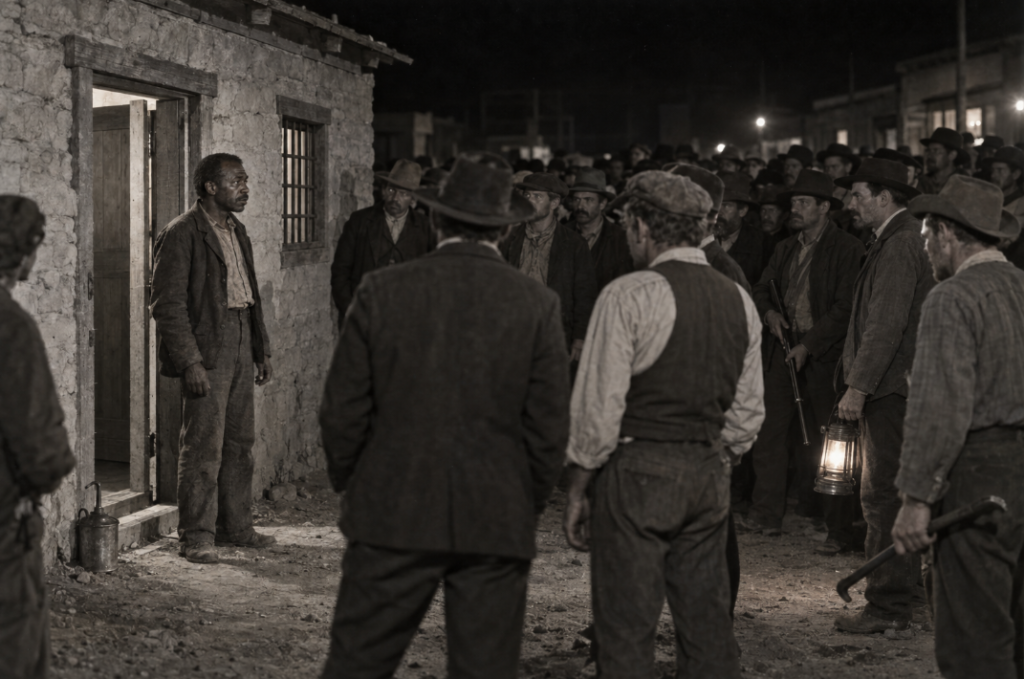
When Deputy Constable Chitwood returned to the little jail at Mojave on the morning of March 12, 1904, the door stood open. Inside, James Cummings, an African-American man, lay dead in a pool of blood.
He had been shot through the body, and portions of his body were covered with heavy black railroad oil and feathers.
His lower clothing had been torn away.
Nearby were the remnants of the attack: a can of lubricating oil, a Southern Pacific lantern and a heavy crowbar believed to have been used to force the jail door.
But, Cummings had not been awaiting trial for a violent crime. He had been convicted of vagrancy and sentenced to sixty days in the county jail at Bakersfield. He was supposed to leave Mojave alive that morning. Instead, sometime during the night, a crowd estimated at thirty to forty men had broken into the jail, dragged him outside, assaulted him, covered him with oil and feathers and returned him to his cell mortally wounded.
Within days, investigators would know the names of many of the men who had been there. Some would confess. Several would be arrested. One man, James Cowan, would eventually be sent to Folsom State Prison. But in the first hours after Cummings’s death, Mojave seemed determined to say almost nothing.
Several saloons stood within a hundred yards of the jail and had remained open during the night. Two deputy constables had slept less than two hundred yards away. Yet officers could find virtually no one willing to admit hearing a gunshot, seeing a crowd or knowing that anything unusual had happened. The silence would not last.
Rumours, Arrest and a Sixty-Day Sentence
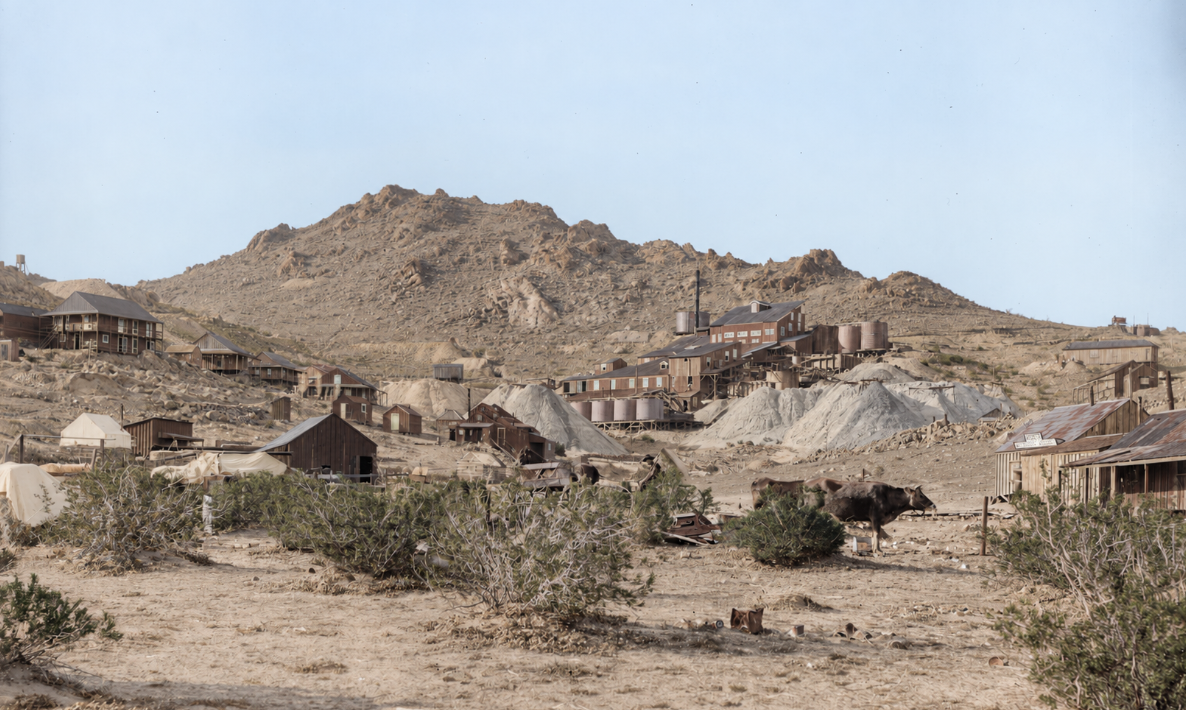
Cummings had arrived in Mojave only a few days earlier, apparently aboard a freight train. He was about forty-five years old and believed to have been born in California. Little else about his life was recorded. He had no money and spent time around the railroad station, saloons and nearby businesses, and almost immediately stories began to circulate about him.
There had been a fight with a younger man. There were claims that Cummings had carried a revolver and razor and had threatened people who refused him drinks, although even at the time those reports were difficult to pin to anyone willing to take responsibility for them. Then came a much more serious accusation. One account said an unidentified young man had accused Cummings of an “infamous crime” before disappearing from town. Another rumour involved the mistreatment of a child. An investigation of Cummings’s movements reportedly found no evidence that he had been near a child, and Justice Reddy, who dealt with the case, was said to have doubted that there was any basis for the more serious allegation.
Cummings’s race was repeatedly emphasized in contemporary coverage, and the speed with which rumor hardened into hostility is difficult to separate from the racial attitudes of the period.
Whatever suspicions circulated in Mojave, none resulted in a criminal charge. Cummings was arrested for vagrancy. He appeared before Justice Reddy, made no defense to that charge and was sentenced to sixty days in the county jail. Deputy Constable Chitwood planned to take him to Bakersfield on an afternoon train but missed it, so Cummings was locked in the Mojave calaboose overnight, with arrangements to take him on the train passing through around four o’clock the next morning.
That delay proved fatal.
“There Was Going to Be Some Fun”
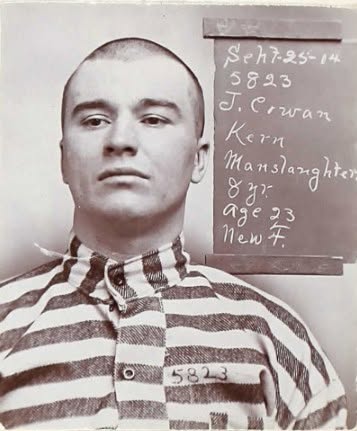
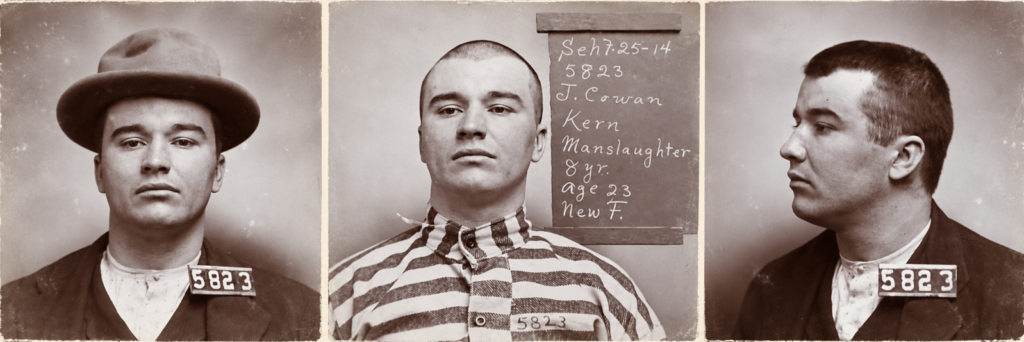
Among the men in Mojave that evening was James Edward Cowan, a Newfoundland-born miner who lodged at a house kept by Mrs. Mary James. Cowan had been born on July 15, 1880, in St. John’s, Newfoundland, the son of Robert Augustus Cowan and Margaret Roche. He was twenty-three years old at the time of Cummings’s death and had moved to California to work in the mining industry.
Cowan had previously left a .38-caliber rifle in his landlady’s care. On Friday night, he came to retrieve it. Mrs. James had heard the talk surrounding the prisoner and feared trouble, and she warned Cowan against taking the weapon. Cowan assured her that he was not going to kill anyone. She gave him the rifle.
Shortly afterward, Cowan was heard telling a barber that there was going to be “some fun” downtown. William Jones, a Southern Pacific hostler, later recalled hearing a similar remark. During the evening, men began gathering around the jail.
The participants would later insist that they had not gone there intending to kill Cummings. Their plan, they said, was to cover him with oil and feathers, a public humiliation that newspapers of the period routinely described as tarring and feathering. The substance they actually used appears to have been heavy lubricating or crude oil associated with the railroad.
The Mob Breaks Into the Jail
Someone forced open the jail door. What happened immediately afterward would remain disputed, even after Cowan had been convicted.
According to one of the men who later confessed, William Clancey, Cummings came running out of the jail and advanced angrily toward the crowd. Cowan fired a shot into the air. When Cummings continued forward, a second shot was fired and a struggle followed. Other witnesses also described Cowan firing twice. Some believed that the second bullet struck Cummings as he came from the jail, but they did not immediately realize he had been wounded because he continued fighting with the men around him.
At some point Cummings was forced to the ground. One witness gave a particularly disturbing account: while Cummings was being held down, Cowan allegedly pushed the muzzle of the rifle into his face and threatened to blow his brains out if he did not lie still. The witness said he pushed the rifle aside and told Cowan there was to be no shooting. Cummings then stopped resisting. The men apparently thought fear had subdued him. It is possible that by then he was already dying.
The physical evidence complicated the eyewitness accounts. Dr. Dempsey, who examined the body, found a single bullet wound entering Cummings’s right side and passing out through his back. The wound traveled downward. From its angle, the doctor believed Cummings may have been kneeling when he was shot, with the gunman standing above him. That did not fit neatly with the later description of Cummings being struck while advancing from the doorway. The discrepancy was never fully resolved – for obvious reasons.
Nor was it certain exactly when Cummings died. The men continued with the punishment they had planned. His lower garments were removed or torn away, oil and feathers were applied to his body, and he was dragged back inside the jail before the crowd dispersed. Some participants later claimed that they did not know Cummings had been shot. Others said they did not realize he was dead when they left. It is hard to believe them.
By Morning, Cummings Was Dead
At about eleven o’clock, Cowan returned to Mrs. James’s lodging house and gave the rifle back. It was stained with black oil, and feathers were sticking to it.
By morning, Cummings was dead.
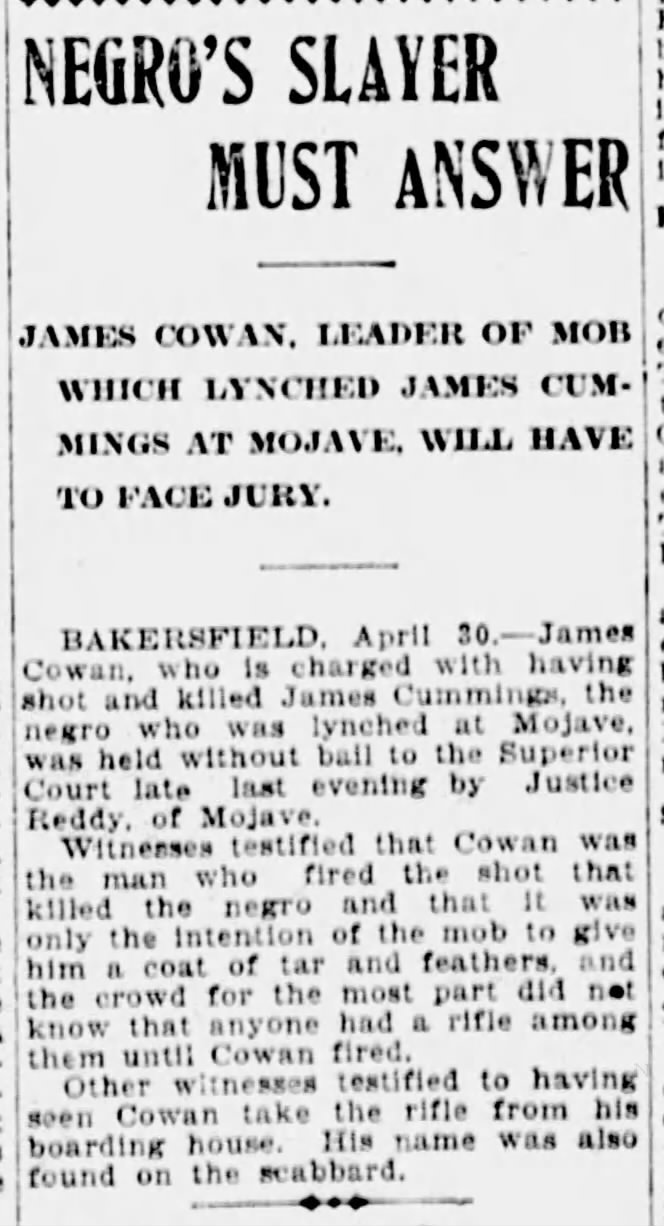
Investigators quickly began finding evidence. An empty .38-caliber shell was discovered at or near the jail and was said to fit Cowan’s rifle. A later search found a bullet embedded in a partition about five feet above the floor, possibly from one of the shots fired during the attack. Witnesses placed the rifle in Cowan’s possession before the mob gathered, and his name was reportedly found on its scabbard.
At first, however, the case was hampered by the reluctance of witnesses to speak. It was revealed some time later that they had been warned to keep quiet. The coroner’s jury concluded that Cummings had died from a gunshot wound and found sufficient evidence to hold Cowan, although it described the fatal injury as having been inflicted by ‘parties unknown.’
Mojave begins to Talk
Several other men were arrested or sought as officers tried to identify the mob. The contemporary reports differ over exactly who was held and when, but among the names that emerged were William Clancey, C. O’Neil, William Yancey, A. Cuddeback, William Jones and later Louis Gamble. Then the silence began to break.
Within days, approximately ten to twelve men had given statements to Justice Reddy, Sheriff Kelly and District Attorney J. W. P. Laird. Some admitted being part of the crowd. Their accounts placed responsibility for the shooting squarely on Cowan. They said the others had gone to the jail intending only to oil and feather Cummings, while Cowan had brought the rifle and fired despite warnings from other men not to shoot.
William Clancey gave Sheriff Kelly his own account from the Bakersfield jail. He acknowledged joining the mob and described Cummings rushing from the jail, Cowan firing once and then firing again before the struggle and the application of oil and feathers.
Cowan denied the accusation. From jail he wrote to his mother, Mrs. Margaret Cowan, in St. John’s, Newfoundland. He told her that his run of bad luck seemed to have reached its limit and insisted that he had been charged with a crime of which he knew “absolutely nothing.” “I swear before all I love and reverence,” he wrote, “I know nothing of it. Pray for me.” He made similar claims in letters to friends, asking them to contribute money for his defense and describing himself as the victim of a conspiracy.
The investigation, however, now presented officials with an unusual problem: there may have been as many as forty men around the jail. Many were known. Some worked for the railroad. Arresting all of the railroad employees believed to have participated could interfere with operations at Mojave, so Trainmaster Trepanier vouched that the men would appear when required.
There was also the expense. Sheriff Kelly estimated that prosecuting everyone who might be liable on felony charges would cost Kern County at least $25,000 and possibly much more. Officials considered whether a grand jury should concentrate only on the leaders.
Cowan, meanwhile, became the central defendant. At his preliminary examination in late April, witnesses testified that he had fired the shot that killed Cummings. Others testified that they had seen him take the rifle from his boarding house. Justice Reddy ordered him held without bail for trial in Superior Court.
The People v. James Cowan
The case of the People v. James Cowan began before Judge J. W. Mahon in Bakersfield on June 21. Cowan faced a murder charge. The evidence placed him with the mob, armed with a rifle, and connected that rifle to the scene. Eyewitnesses accused him of firing. Yet when the jury finally retired, the case proved far less straightforward than the early investigation had suggested.
The jurors deliberated for almost twenty-four hours. One held out through the night for a conviction of first-degree murder carrying the death penalty. The other eleven, did not believe Cowan had fired the bullet that killed Cummings.
Even so, they did not believe he should be acquitted. Their reasoning was that Cowan had willingly joined a mob that took a prisoner from lawful custody and assaulted him. Cummings was fatally shot while that illegal attack was underway. Cowan therefore shared responsibility for the death whether or not his rifle fired the fatal round.
There was another consideration. The jurors reportedly felt it would be unjust to punish one participant with exceptional severity when so many others had taken part in the same mob. Their verdict was therefore a compromise: Cowan was found guilty of manslaughter, with a recommendation for leniency.
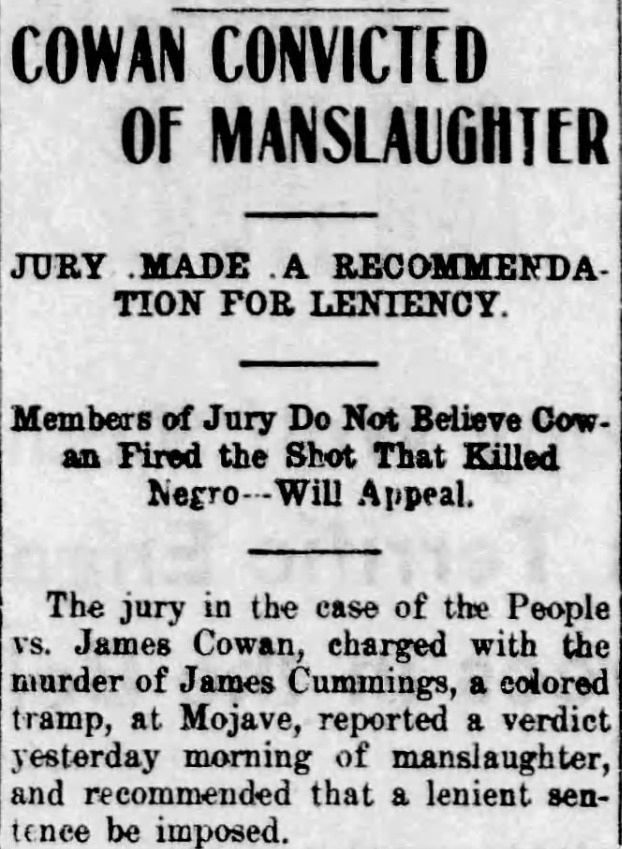
His lawyer, M. S. Platz, immediately sought a new trial, alleging errors of law, misconduct by the court and prosecution, newly discovered evidence and a verdict contrary to the evidence. Judge Mahon denied the motion on July 22.
Before sentence was imposed, Cowan rose to speak despite his attorney’s wishes. His statement differed significantly from the complete denial he had sent his mother in March. Cowan now admitted that he had fired a shot into the calaboose, but he insisted that his bullet had not struck Cummings.
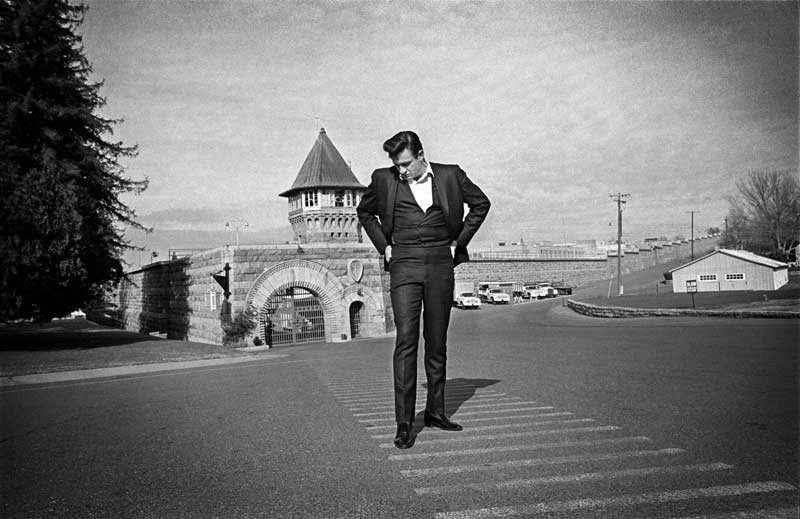
Judge Mahon sentenced him to eight years in Folsom State Prison. He said the jury’s recommendation for mercy had saved Cowan from a more severe sentence, although he questioned whether the jury should have made such a recommendation at all.
Eight Years in Folsom
Cowan appealed to the California Supreme Court. He was denied bail while the appeal was pending and in September was sent to Folsom. In August 1905, the California Supreme Court affirmed the judgment.
Cowan would serve his sentence while the others in the mob would walk free.
Later records trace Cowan’s life after his imprisonment. By 1920, James Cowan was living in Inyo County, California and was working as a successful operator of a tourist resort. He lived with his wife, Alice, and their son, Robert. By 1936, James Edward Cowan was living in Venice Beach, California, where he would eventually die at his home at 1816 Pacific on Friday, June 19, 1936. Funeral services were held three days later and he was buried at Forest Lawn Memorial Park in Glendale later to be near the graves of Michael Jackson, Walt Disney, Elizabeth Taylor and many others.
A Death Without Full Accountability
The wider mob largely disappeared from the legal story. That may be the most unsettling part of what happened in Mojave. Authorities had evidence that dozens of men were present. Several admitted participating. They had broken into a jail, removed a prisoner, held him down, stripped him, covered him with oil and feathers and dragged him back into custody after shots had been fired. Yet the case eventually narrowed to one defendant.
Even in Cowan’s case, the central factual question was never completely settled. Numerous witnesses identified him as the man who fired the fatal shot, and the prosecution believed he was the killer. But most of the jury reportedly did not. The physical evidence also left questions. The downward path of the bullet suggested one position for Cummings; some eyewitness accounts suggested another.
What is certain is simpler. James Cummings, a black man, had been in Mojave for only a few days. Rumours attached themselves to him quickly, but the only offense for which he was convicted was vagrancy. The court sentenced him to sixty days. Before that sentence could even begin, a crowd decided to administer a punishment of its own.
They went to the jail at night, forced the door, took Cummings out, assaulted and humiliated him, and somewhere in the violence a rifle was fired. Before morning, James Cummings was dead. The men who participated would later argue about who intended what, who knew he had been shot and who fired the bullet that killed him.
But none of those disputes changes the event at the center of the case: an African American man who had been placed in the custody of the law was taken from that custody by a mob, brutalized and killed in a community where race shaped how he was described, judged and remembered. And for all the confessions, arrests, testimony and courtroom proceedings that followed, the full responsibility for his death was never borne by anything close to the number of men who gathered outside the Mojave jail that night.